How DNSSEC Works
To query with DNSSEC enabled:
dig @server query +dnssec
Resource Record Set (RRSET)
The first step towards securing a zone with DNSSEC is to group all the records with the same type into a resource record set (RRset). For example, if you have three AAAA records in your zone on the same label (i.e. label.example.com), they would all be bundled into a single AAAA RRset.
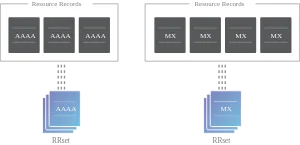
DNSSEC doesn't work on individual records but on sets of records — the RRSETs.
Zone-Signing Keys
Each zone in DNSSEC has a zone-signing key pair (ZSK): the private portion of the key digitally signs each RRset in the zone, while the public portion verifies the signature. To enable DNSSEC, a zone operator creates digital signatures for each RRset using the private ZSK and stores them in their name server as RRSIG records. This is like saying, "These are my DNS records, they come from my server, and they should look like this."
RRSIG
It stores the digital signature of the RRSET using public and private keys.
The how
First we take the RRSET (plain text). We run it through a signing process, which uses the private part of the ZSK to create a signature. This output — the signature — is stored alongside the plain text RRSET using the same name with record type RRSIG.
Normal clients will only see the RRSET, whereas DNSSEC clients will see the RRSIG as well.
- >If the RRSET changes, the RRSIG has to be regenerated in order to be valid.
- >If the RRSET changes without a corresponding change in the RRSIG, the signature is considered invalid.
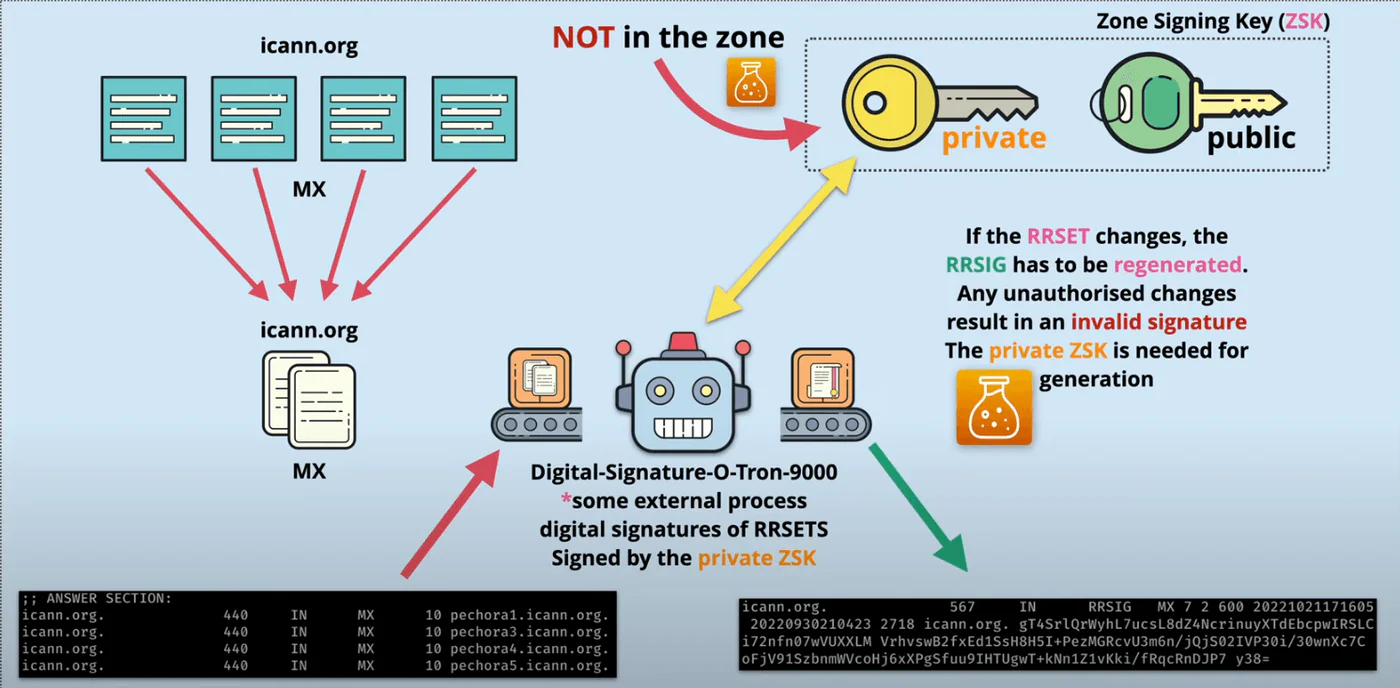
Records of the same type and label are grouped into an . The private half of the signs each set, and the signature is stored beside it as an record.
What does DNSSEC sign?