AWS Global Infrastructure
AWSCloudregionsavailability zonesedge locations
Regions
- >All around the world, like
us-east-1,eu-west-3, etc. - >A cluster of data centers.
- >Changing the region depends on:
- >Compliance — data of the EU should stay in the EU.
- >Latency — if the customer is in America, choosing the EU region increases latency.
- >Available services — a Singapore region may not have all the latest features that America has.
- >Pricing — pricing varies from one region to another.
Availability zones
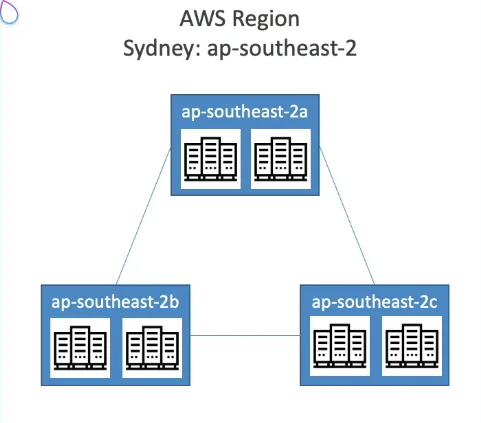
- >Each region has a minimum of 3 and a maximum of 6 availability zones.
- >Actual data centers with all the supporting services, like power and networking.
- >Kept separate so that disasters won't affect one another.
- >Connected to each other through high-bandwidth, super-speed connections.
Expand
Point of presence / edge locations
- >Amazon has 400+ Points of Presence (400+ edge locations and 10+ regional caches) in 90+ cities across 40+ countries.
- >Content is delivered to end users with lower latency.
Global versus region-scoped services
AWS has global services:
- >Identity and Access Management (IAM)
- >Route 53 (DNS service)
- >CloudFront (Content Delivery Network)
- >WAF (Web Application Firewall)
Most AWS services are region-scoped:
- >Amazon EC2 (Infrastructure as a Service)
- >Elastic Beanstalk (Platform as a Service)
- >Lambda (Function as a Service)
- >Rekognition (Software as a Service)
AWS scope4 blanks
Each region has between and availability zones. IAM, Route 53, CloudFront and WAF are services, while EC2, Lambda and Rekognition are -scoped.
try it before revealing